Chatbots vs. AI Assistants: Understanding the Key Differences
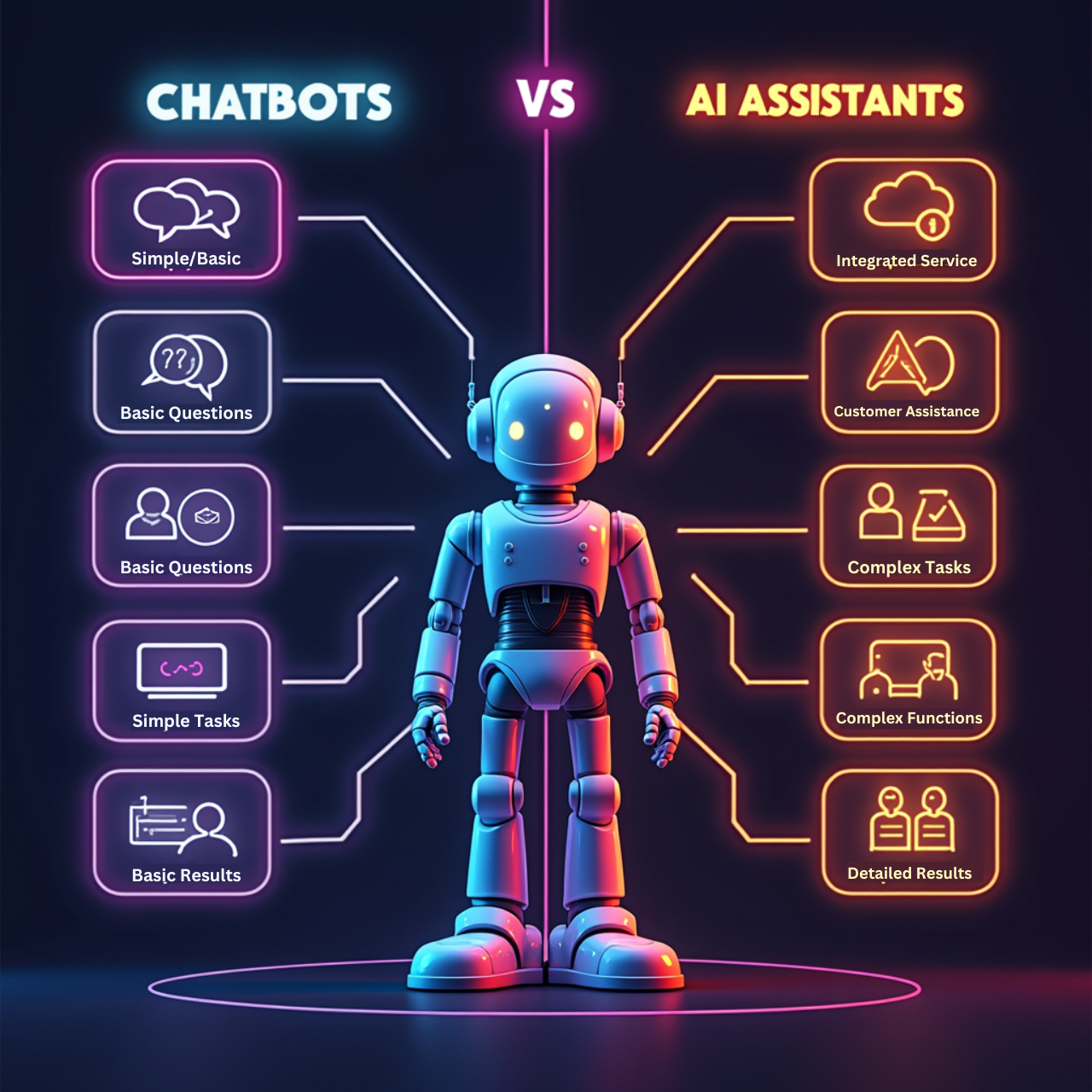
This blog explores the differences between chatbots and AI assistants, highlighting five key distinctions: functionality, learning capabilities, conversational complexity, integration scope, and personalization. Chatbots are excellent for handling simple, repetitive tasks but fall short when deeper engagement or adaptability is required. AI assistants, on the other hand, use machine learning to evolve, handle complex interactions, and integrate across multiple systems, making them ideal for businesses aiming to enhance customer engagement and streamline operations. The blog provides insights into how businesses can benefit from both tools depending on their needs, with AI assistants offering more robust solutions for long-term growth.
Low-code tools are going mainstream
Purus suspendisse a ornare non erat pellentesque arcu mi arcu eget tortor eu praesent curabitur porttitor ultrices sit sit amet purus urna enim eget. Habitant massa lectus tristique dictum lacus in bibendum. Velit ut viverra feugiat dui eu nisl sit massa viverra sed vitae nec sed. Nunc ornare consequat massa sagittis pellentesque tincidunt vel lacus integer risu.
- Vitae et erat tincidunt sed orci eget egestas facilisis amet ornare
- Sollicitudin integer velit aliquet viverra urna orci semper velit dolor sit amet
- Vitae quis ut luctus lobortis urna adipiscing bibendum
- Vitae quis ut luctus lobortis urna adipiscing bibendum
Multilingual NLP will grow
Mauris posuere arcu lectus congue. Sed eget semper mollis felis ante. Congue risus vulputate nunc porttitor dignissim cursus viverra quis. Condimentum nisl ut sed diam lacus sed. Cursus hac massa amet cursus diam. Consequat sodales non nulla ac id bibendum eu justo condimentum. Arcu elementum non suscipit amet vitae. Consectetur penatibus diam enim eget arcu et ut a congue arcu.

Combining supervised and unsupervised machine learning methods
Vitae vitae sollicitudin diam sed. Aliquam tellus libero a velit quam ut suscipit. Vitae adipiscing amet faucibus nec in ut. Tortor nulla aliquam commodo sit ultricies a nunc ultrices consectetur. Nibh magna arcu blandit quisque. In lorem sit turpis interdum facilisi.
- Dolor duis lorem enim eu turpis potenti nulla laoreet volutpat semper sed.
- Lorem a eget blandit ac neque amet amet non dapibus pulvinar.
- Pellentesque non integer ac id imperdiet blandit sit bibendum.
- Sit leo lorem elementum vitae faucibus quam feugiat hendrerit lectus.
Automating customer service: Tagging tickets and new era of chatbots
Vitae vitae sollicitudin diam sed. Aliquam tellus libero a velit quam ut suscipit. Vitae adipiscing amet faucibus nec in ut. Tortor nulla aliquam commodo sit ultricies a nunc ultrices consectetur. Nibh magna arcu blandit quisque. In lorem sit turpis interdum facilisi.
“Nisi consectetur velit bibendum a convallis arcu morbi lectus aecenas ultrices massa vel ut ultricies lectus elit arcu non id mattis libero amet mattis congue ipsum nibh odio in lacinia non”
Detecting fake news and cyber-bullying
Nunc ut facilisi volutpat neque est diam id sem erat aliquam elementum dolor tortor commodo et massa dictumst egestas tempor duis eget odio eu egestas nec amet suscipit posuere fames ded tortor ac ut fermentum odio ut amet urna posuere ligula volutpat cursus enim libero libero pretium faucibus nunc arcu mauris sed scelerisque cursus felis arcu sed aenean pharetra vitae suspendisse ac.
Chatbots vs. AI Assistants: Understanding the Key Differences
As businesses evolve and adopt new technologies, tools like AI for marketing, voice AI generators, and AI consultants are transforming the customer experience. Many companies are now using AI tools for marketing and customer service automation, but what's the difference between chatbots and AI assistants? While both are popular choices for businesses looking to automate processes, their functionality, learning capabilities, and overall complexity differ significantly. Understanding these differences is crucial in choosing the right tool to elevate your business.
In this article, we’ll break down the five key differences between chatbots and AI assistants to help you make the right choice for your business.
1. Basic Functionality: Chatbots vs. AI Assistants
Chatbots are primarily task-oriented, focusing on handling basic queries like FAQs or simple service requests. If a customer is looking for store hours, tracking information, or payment instructions, a chatbot can easily retrieve this data from a predefined database. Chatbots work best when used for straightforward tasks that don’t require much interaction beyond a simple exchange of information.
However, AI scheduling assistants and AI voice generators provide much more than basic functionality. AI assistants are multi-functional and can manage complex tasks across various domains, including customer service, scheduling, and data analysis. For example, an AI business planner doesn’t just analyze customer data to provide personalized solutions—it also proactively recommends strategies based on a customer’s behavior. The assistant can coordinate appointments, answer in-depth questions, and even manage a CRM system simultaneously.
This depth of interaction makes AI assistants far more valuable for businesses looking for a comprehensive tool to manage multiple business operations. In contrast, chatbots are best suited for handling simple, repetitive tasks that can be scripted in advance.
2. Learning Capabilities: Chatbots Follow Scripts, AI Assistants Learn and Adapt
One of the key differences between chatbots and AI assistants lies in their learning capabilities. Chatbots typically follow pre-written scripts, making them ideal for handling frequently asked questions or straightforward tasks. For instance, if a customer types in “What’s the status of my order?”, the chatbot will recognize the keyword “order” and retrieve relevant information from a database.
However, the limitation of chatbots is that they do not adapt or learn from user interactions. If the customer’s query falls outside the predefined script, the chatbot may struggle to provide a helpful response. This often results in user frustration, as chatbots are unable to think beyond the instructions they’ve been programmed to follow.
AI assistants, on the other hand, use machine learning and natural language processing (NLP) to understand context and adapt over time. They can learn from previous interactions and evolve their responses based on user preferences, making them much more adaptable than chatbots. For example, AI scheduling tools don’t just follow instructions—they recognize user patterns, anticipate needs, and provide solutions based on past interactions. In customer service, an AI call center assistant can provide personalized responses to unique inquiries and learn from each interaction, improving over time.
This adaptability makes AI assistants invaluable for businesses that require dynamic, personalized engagement with customers, while chatbots are limited by their inability to learn.
3. Conversational Complexity: Chatbots Handle Simple Queries, AI Assistants Engage in Natural Conversations
When it comes to handling conversational complexity, chatbots and AI assistants are worlds apart. Chatbots are designed to manage simple, transactional conversations. If a customer asks, “What are your hours?” or “What is the shipping policy?”, a chatbot can respond quickly and accurately. However, as soon as the conversation becomes more complex or requires deeper interaction, chatbots may fail.
This is where AI assistants excel. Powered by advanced algorithms and natural language processing, AI assistants are capable of understanding the context of a conversation and can engage in more dynamic exchanges. For example, an AI phone caller system can answer customer queries about products, assist with troubleshooting, and even suggest upsells—all while maintaining the flow of conversation. Furthermore, AI assistants can remember details shared earlier in the interaction, allowing them to provide a seamless experience that feels more human.
Voice generator AI systems are another example of how AI assistants can manage more complex tasks. These tools can engage users with voice commands, conduct back-and-forth conversations, and offer suggestions based on user intent. This level of sophistication allows businesses to create more meaningful interactions with customers, particularly in service-based industries like healthcare, finance, and retail.
Chatbots may be sufficient for basic inquiries, but AI assistants are better equipped to handle more intricate conversations that require an understanding of context and nuance.
4. Integration and Scope: Chatbots Serve Specific Roles, AI Assistants Span Multiple Functions
The scope of what a chatbot can do is generally narrow, as they are designed to serve specific roles. A chatbot might handle customer service inquiries or help users navigate a website, but it will typically only integrate with one or two systems. For example, a chatbot in a retail setting may be linked to an order-tracking system, but it likely won’t connect with inventory, marketing, or customer feedback systems without significant reprogramming.
In contrast, AI assistants are designed for broader integration across multiple platforms and systems. An AI scheduling assistant can access a company’s CRM, scheduling software, and email system simultaneously, streamlining workflows and increasing efficiency. This makes AI assistants ideal for businesses that operate across multiple departments or have complex workflows that require real-time coordination.
For example, in a call center AI environment, an assistant could answer customer inquiries, schedule follow-up calls, and provide insights to management about call trends—all from one integrated system. This type of cross-functional integration makes AI tools for marketing particularly powerful, as they can access customer data, analyze trends, and suggest campaign strategies that increase engagement and ROI.
The ability to integrate with a wide array of systems and provide value across different areas of the business makes AI assistants far more versatile than chatbots, which are limited to single-function roles.
5. Customization and Personalization: Chatbots Offer Predefined Interactions, AI Assistants Deliver Tailored Experiences
Customization is another area where chatbots and AI assistants differ greatly. Most chatbots operate on predefined pathways, offering a uniform experience to every user. For instance, a chatbot designed to answer questions about returns will give the same response to every user, regardless of their purchase history or customer profile. While this can be sufficient for simple, repetitive tasks, it doesn’t allow for any meaningful personalization.
AI assistants, on the other hand, excel at delivering personalized experiences. AI business planners and AI tools for marketing can analyze user data and tailor responses based on individual preferences. For instance, if a customer regularly interacts with a certain type of product, the AI assistant can recommend similar products or suggest additional services. Similarly, an AI for small business assistant can offer specific advice based on the business’s operational history and industry trends.
In industries like healthcare, AI call center assistants can provide personalized care recommendations based on a patient’s medical history, while in retail, they can suggest products based on past purchases and browsing behavior. This level of personalization creates a much deeper connection with the customer and enhances the overall user experience.
Customization is essential in today’s business landscape, where consumers expect tailored interactions. AI assistants provide this level of customization, while chatbots, limited by their programming, cannot.
Conclusion: Choosing Between Chatbots and AI Assistants
Both chatbots and AI assistants have a place in today’s business world, but understanding their differences is crucial for making the right choice. Chatbots are best suited for simple, repetitive tasks like handling FAQs or guiding users through basic processes. They’re ideal for businesses that need a cost-effective, easy-to-implement solution for straightforward customer service needs.
AI assistants, on the other hand, offer a more advanced, multi-functional solution. Whether it’s AI scheduling assistants, AI phone callers, or AI tools for digital marketing, AI assistants can manage complex workflows, learn from user interactions, and deliver personalized experiences. They’re perfect for businesses looking for long-term growth, improved customer engagement, and higher operational efficiency.
Ultimately, the decision comes down to your business’s needs. If you require basic automation, a chatbot may suffice. But if you're aiming for personalized, scalable solutions, AI assistants powered by tools like voice AI generators and AI for marketing will offer the flexibility and sophistication your business needs to thrive in the modern marketplace.

Unlock the full potential of your business with Tixae.ai. Our cutting-edge AI agents go beyond the capabilities of traditional chatbots, providing personalized, multi-functional support to streamline your operations. Whether you're looking to boost customer engagement, automate tasks, or enhance scheduling, Tixae Agents offer advanced AI solutions tailored to your needs. Visit Tixae.ai today and see how our AI-powered assistants can transform your business!